
Patient Acquisition ROI & Tracking for Pediatric Practices
Direct answer
Short Answer
The complete guide to Cost per patient, attribution, call tracking, conversion tracking, dashboards, marketing ROI measurement for pediatric practices — strat
- The article covers what patient acquisition roi actually means for pediatric practices.
- The article covers the four metrics every pediatric practice must track.
- The article covers building your tracking infrastructure: the technology stack.
- The article covers how to calculate true cost per patient (with real attribution).
| Question | Answer |
|---|---|
| Primary topic | Patient Acquisition ROI & Tracking for Pediatric Practices |
| Recommended metric | Cost per verified booked patient |
Last updated: May 4, 2026
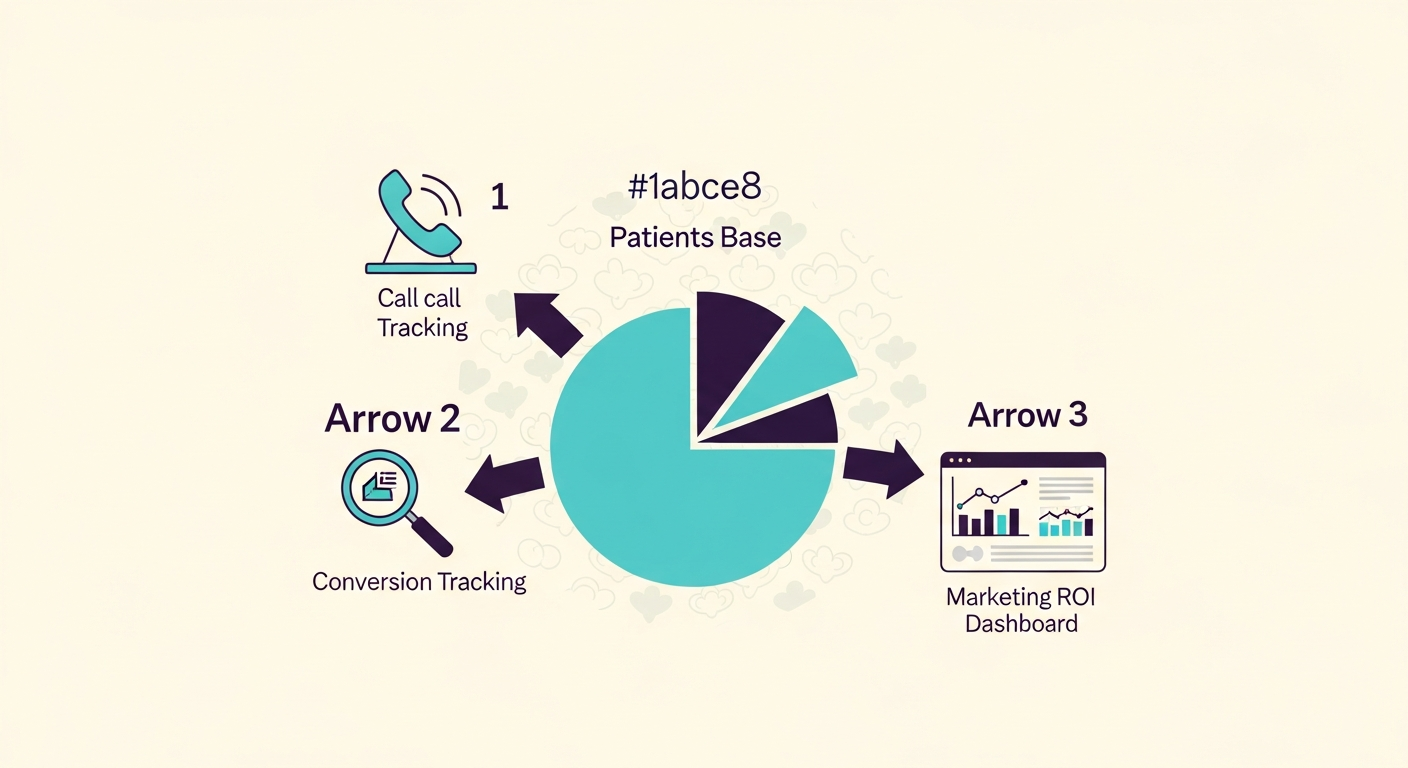
Patient acquisition ROI for pediatric practices averages $180–$320 per new patient across paid channels in 2025, but most practices can't measure it accurately because they don't connect marketing spend to actual booked appointments. Without proper tracking infrastructure—call tracking numbers, conversion pixels, CRM attribution, and centralized dashboards—you're spending blindly. This guide walks through the entire measurement stack pediatric practices need to calculate true cost per patient, identify which channels work, and stop wasting budget on tactics that don't convert.
What Patient Acquisition ROI Actually Means for Pediatric Practices
What is patient acquisition ROI? Patient acquisition ROI is the ratio of lifetime patient value to the cost of acquiring that patient through marketing. For pediatric practices, this calculation must account for multi-year patient relationships and the average family bringing 2.3 children over a typical 6–8 year engagement period.
Most practices confuse marketing activity with marketing performance. Posting on social media feels productive. Running Google Ads generates clicks. But neither tells you if you're profitable. True ROI measurement answers three questions: What did this patient cost to acquire? What revenue will they generate? Which marketing channel brought them in?
The average pediatric practice loses visibility on 40–60% of new patient conversions because they lack proper attribution. A parent searches Google, clicks your ad, visits your website, calls three days later from a phone number they saved, and your front desk books them. Without call tracking tied to that original ad click, you just spent $47 on a Google Ads conversion you'll never count.
By the numbers: Practices with proper attribution tracking report 34% higher marketing ROI than those relying on "How did you hear about us?" intake forms, according to a 2024 MGMA practice operations survey1.
The Four Metrics Every Pediatric Practice Must Track
You need four core numbers to measure patient acquisition performance. Most practices track zero or one of these systematically.
Cost Per Lead (CPL)
Cost per lead is total marketing spend divided by total leads generated—phone calls, form submissions, chat messages. For pediatric practices running Google Ads, CPL typically ranges $28–$65 depending on market competitiveness and targeting precision. A lead is not a patient. It's the first measurable signal of interest. Track CPL by channel: Google Ads CPL, Facebook CPL, SEO-driven organic CPL (calculated by attributing your monthly SEO investment across organic form fills and calls).
Lead-to-Patient Conversion Rate
This is the percentage of leads that become scheduled appointments. The national benchmark for pediatric practices sits at 38–52% according to healthcare call tracking data from CallRail's 2024 healthcare vertical report2. If you're below 38%, your problem isn't marketing—it's front desk phone handling. A practice spending $4,000/month on ads with a 25% conversion rate is lighting $3,000 on fire. Fix the phone first, then scale ads.
Cost Per Acquired Patient (CPAP)
CPAP is the real number: total marketing spend divided by new patients scheduled. Calculate this monthly for each channel. For paid channels like Google Ads, pediatric CPAP ranges $180–$320. For organic channels like local SEO, calculate by dividing your monthly SEO investment (including agency fees, content costs, technical work) by new organic patients. If you spend $2,500/month on SEO and it drives 18 new patients, your organic CPAP is $139—substantially better than paid, which justifies long-term SEO investment despite slower ramp time.
Patient Lifetime Value (LTV)
LTV is the total revenue a patient generates over their relationship with your practice. For pediatrics, calculate based on average visit frequency (6.2 visits per year for established pediatric patients per AAP utilization data3), average reimbursement per visit, and average patient tenure. A patient who stays 7 years at 6 visits per year with $180 average reimbursement generates $7,560 in lifetime value. Multiply by 2.3 for average children per family and you're looking at $17,388 family LTV. Suddenly a $280 acquisition cost looks like a bargain with a 62:1 return.
| Metric | Definition | Pediatric Benchmark | Why It Matters |
|---|---|---|---|
| Cost Per Lead | Marketing spend ÷ leads generated | $28–$65 (paid channels) | First indicator of channel efficiency |
| Lead-to-Patient Rate | Scheduled patients ÷ total leads | 38–52% | Reveals phone/conversion problems |
| Cost Per Patient | Marketing spend ÷ new patients | $180–$320 (paid), $90–$150 (organic) | True acquisition cost |
| Patient LTV | Avg revenue per patient over relationship | $7,560 (single child, 7 years) | Determines acceptable acquisition cost |
Building Your Tracking Infrastructure: The Technology Stack
Accurate ROI measurement requires connecting four systems: call tracking, website analytics, your practice management system, and a centralized dashboard. Most practices have pieces of this stack but lack integration, which creates blind spots.
Call Tracking Numbers
Deploy unique tracking numbers for each marketing channel. Use a HIPAA-compliant call tracking platform—CallRail, CallTrackingMetrics, or WhatConverts all offer Business Associate Agreements required for healthcare. Don't use one tracking number across all channels; you'll never know if that new patient came from Google Ads or your website. Dynamic number insertion (DNI) automatically swaps the phone number on your website based on the visitor's traffic source, so Google Ads visitors see a different number than organic visitors. This precision costs $50–$150/month but eliminates guesswork.
Record and transcribe calls. Modern call tracking platforms use AI transcription to identify conversion signals—"Yes, I'd like to schedule," "What times do you have available?"—and automatically flag high-intent calls for follow-up. This feeds lead quality scoring and helps you identify which channels drive ready-to-book callers versus tire-kickers.
Website Conversion Tracking
Install conversion pixels from every paid platform you use: Google Ads conversion tracking, Facebook Pixel, Google Analytics 4 events. Define conversions as actions with intent: form submissions, "Request Appointment" button clicks, phone number clicks on mobile. Don't track page views or time on site as conversions—these are engagement metrics, not conversion events.
Set up Google Analytics 4 event tracking for microconversions—newsletter signups, insurance page views, "Meet Our Doctors" page visits. These signal interest even when the visitor doesn't book immediately. Use GA4's "User ID" feature to track patients across devices and sessions. A parent researches on mobile during lunch, returns on desktop that evening, and books—User ID connects both sessions to one conversion path.
Practice Management System Integration
Your PMS holds the ground truth: who actually showed up. Without connecting marketing data to your PMS, you can't measure no-show rates by acquisition channel or identify whether expensive ad-driven patients are higher or lower quality than organic referrals. Most modern pediatric PMS platforms (Athenahealth, eClinicalWorks, Kareo) offer API access. Use middleware like Zapier or a healthcare CRM like Weave or Solutionreach to push new patient bookings from your PMS back to your marketing dashboard.
Tag each new patient record in your PMS with their acquisition source. Create a required custom field: "How did you hear about us?" with specific options (Google Search, Facebook Ad, Insurance Directory, Friend Referral). Train front desk staff to ask and record this during scheduling. This manual tagging backstops your automated tracking and catches offline conversions—the parent who saw your billboard, Googled your name, and called directly.
Centralized Dashboard
Pull everything into one view. Google Looker Studio (free) connects to Google Ads, Google Analytics, and most call tracking platforms via native integrations. Build a dashboard showing month-over-month: total marketing spend by channel, leads by channel, cost per lead, scheduled patients by channel, cost per patient, and ROI (patient LTV divided by CPAP). Update this monthly. Share it with your practice administrator and physicians who make budget decisions. Numbers drive behavior.
How to Calculate True Cost Per Patient (with Real Attribution)
Here's the formula most practices get wrong: they divide total marketing spend by total new patients and call it done. This ignores multi-touch attribution—the reality that most patients interact with your practice 3–5 times before booking.
The Multi-Touch Attribution Problem
A parent searching for a new pediatrician typically follows this path: sees your Google Business Profile in map results (first touch), visits your website from organic search (second touch), clicks a retargeting ad two days later (third touch), reads online reviews (fourth touch), then calls to book (fifth touch, conversion). Which channel gets credit? Under last-click attribution—Google Analytics' default—the retargeting ad gets 100% credit despite organic search doing most of the work. This systematically overvalues bottom-of-funnel tactics and undervalues awareness drivers.
Use data-driven attribution models in Google Analytics 4 once you have 400+ conversions in a 30-day period. Below that threshold, use position-based attribution: 40% credit to first touch, 40% to last touch, 20% distributed across middle touches. This more accurately reflects how channels work together.
Step-by-Step Cost Per Patient Calculation
- Export all marketing expenses for the month: ad spend, agency fees, content costs, SEO tools, call tracking software. Total: $6,840.
- Pull new patient count from your PMS for the same month: 34 new patients scheduled.
- Divide total spend by new patients: $6,840 ÷ 34 = $201 blended cost per patient.
- Break down by channel using attribution from your dashboard. If Google Ads drove 14 new patients at $2,200 spend, that's $157 per patient. If SEO drove 12 patients at $2,500 investment (agency fee), that's $208 per patient. If referrals drove 8 patients at $0 direct cost, that's $0 per patient (though you may allocate soft costs like referral appreciation events).
- Compare channel CPAPs to patient LTV. Any channel with CPAP under 15% of LTV is sustainably profitable. For $7,560 patient LTV, that's $1,134 maximum acceptable CPAP—you have substantial room to scale.
Channel-Specific ROI Benchmarks for Pediatric Practices
Different channels perform differently. Here's what typical ROI looks like across six common acquisition channels based on 2024–2025 healthcare marketing data.
| Channel | Typical CPAP | Time to ROI | LTV:CPAP Ratio | Best For |
|---|---|---|---|---|
| Google Ads (Search) | $180–$320 | Immediate | 24:1 to 42:1 | Fast patient volume, competitive markets |
| Local SEO | $90–$150 | 4–7 months | 50:1 to 84:1 | Long-term sustainable growth |
| Facebook/Instagram Ads | $240–$450 | Immediate | 17:1 to 31:1 | Awareness, new practice launch |
| Physician Referrals | $0–$50 | Ongoing | 150:1+ | Subspecialty, established practices |
| Insurance Directories | $0–$30 | Ongoing | 250:1+ | Passive baseline, all practices |
| Direct Mail | $380–$650 | Immediate | 12:1 to 20:1 | Geographic saturation, new practice |
Local SEO delivers the best long-term ROI for established practices because acquisition costs drop over time as your organic rankings compound. A practice investing $2,000/month in SEO might drive 8 new patients in month three ($250 CPAP), 14 in month six ($143 CPAP), and 22 by month twelve ($91 CPAP). The asset you're building—domain authority, citation consistency, content depth—continues working without ongoing spend.
Google Ads offers the fastest ROI. You can launch a campaign Monday and have new patient calls by Wednesday. But costs never decrease—in fact, pediatric CPCs have risen 18% year-over-year in competitive markets according to WordStream's 2025 healthcare benchmarks4. Use paid search to fill your schedule while SEO ramps, then optimize the ratio as organic volume grows.
Common Attribution Mistakes That Inflate Reported ROI
Most pediatric practices accidentally overcount conversions or misattribute them, which makes bad channels look good and leads to wasted budget.
Counting Every Form Fill as a New Patient
A website form submission is a lead, not a patient. If your analytics dashboard shows 47 "conversions" last month but your PMS shows 34 new patients scheduled, you have a 28% drop-off between lead and booking. Track both numbers separately. Improve the gap through better front desk phone training and faster lead response time. Practices that call back web form leads within 5 minutes convert at 63%, while those waiting 24+ hours convert at 18%.
Ignoring No-Shows in ROI Calculations
A scheduled patient who doesn't show up generated zero revenue but still cost you $280 to acquire. Track no-show rates by acquisition channel. In our experience managing campaigns across pediatric practices, Google Ads patients no-show at 12–14%, while referral patients no-show at 4–6%. This means your effective cost per seen patient from Google Ads is actually 14% higher than your cost per scheduled patient. Adjust your ROI calculations accordingly.
Forgetting to Include Agency Fees and Tool Costs
If you spend $3,000/month on Google Ads and pay your agency $1,500/month to manage it, your real marketing spend is $4,500, not $3,000. Include everything: ad spend, agency fees, software subscriptions (call tracking, SEO tools, scheduling software with marketing features), content creation costs, website hosting, and any internal staff time allocated to marketing. Undercounting costs makes ROI look better on paper while you lose money in reality.
Using "How Did You Hear About Us?" as Your Only Attribution
Patients are terrible at remembering their true acquisition path. They'll say "Google" when they actually saw your Facebook ad, Googled your name as a direct result, and called from the organic search result. This systematically undercounts paid channels that drive awareness. Use "How did you hear about us?" as a backup data point, not your primary attribution method. Technology-based tracking—call tracking numbers, UTM parameters, conversion pixels—captures what actually happened, not what the patient thinks happened.
Building a Monthly ROI Dashboard (with Free Tools)
You don't need expensive business intelligence platforms. Google Looker Studio connects free to most marketing data sources and provides exactly what pediatric practices need for monthly ROI review.
Essential Dashboard Components
Your dashboard needs six sections viewable at a glance. First: month-over-month marketing spend by channel displayed as a stacked column chart. Second: new patients by channel as a bar chart with color coding (green for channels under target CPAP, yellow for at-target, red for over). Third: a scorecard section showing four big numbers—total marketing spend, total new patients, blended CPAP, and percentage change from last month. Fourth: cost per patient by channel as a sorted table (lowest CPAP at top). Fifth: lead-to-patient conversion rate by channel as a gauge chart with benchmark zones. Sixth: a line graph showing trailing 12-month CPAP trend to reveal whether your acquisition costs are rising or falling over time.
Setting Up Automated Data Connections
Connect Google Ads directly via native integration—no manual exports. Connect Google Analytics 4 via native integration and create a custom segment for "Users who scheduled" by filtering to sessions with thank-you page views or form submission events. Connect call tracking using your platform's Looker Studio connector (CallRail and CallTrackingMetrics both offer native integrations). Pull PMS data manually via monthly CSV export of new patients with source codes—most PMS platforms don't offer direct API connections to Looker Studio, so this stays manual unless you invest in middleware.
Monthly Review Cadence
Block 90 minutes on the third business day of each month. Pull last month's data, update your dashboard, and review with your practice administrator. Ask four questions: (1) Which channel drove the lowest cost per patient last month? (2) Are we at capacity for new patients, or should we increase spend on our best-performing channel? (3) Did any channel's CPAP increase more than 15% month-over-month, signaling a problem? (4) What's our overall ROI (calculated as total LTV from new patients divided by total marketing spend)? Document decisions—if Google Ads performed well, allocate $500 more budget next month and measure the result.
When to Scale Spend vs. When to Cut Budget
Too many practices increase marketing budget when they're busy and cut it when they're slow—exactly backward. Scale when your CPAP is below target and you have appointment availability. Cut when CPAP rises above acceptable thresholds or you're already booked solid.
The CPAP Scaling Formula
Calculate your maximum acceptable CPAP: patient LTV multiplied by your target ROI ratio. If your LTV is $7,560 and you want 10:1 ROI minimum (typical for sustainable patient acquisition), your maximum CPAP is $756. Any channel consistently delivering below $756 per patient has room to scale. Increase budget by 20–30% monthly on these channels and watch whether CPAP holds steady or rises. If Google Ads delivers $220 CPAP at $3,000/month spend, try $3,900 next month. If CPAP stays under $270, scale again. If it jumps to $380, you've hit saturation—pull back to $3,200 and optimize campaign structure instead of spending more.
Warning Signs to Cut Budget
Cut spend immediately when: (1) CPAP exceeds your maximum acceptable threshold for two consecutive months, (2) lead-to-patient conversion rate drops below 30% without explanation (this signals front desk issues, not channel issues—fix the root cause before spending more), (3) your new patient schedule is booked 4+ weeks out consistently (you're demand-constrained, not supply-constrained), or (4) a channel's CPAP rises 40%+ month-over-month, indicating major auction competition changes or targeting problems requiring strategic overhaul before additional spend.
Advanced Tactics: Cohort Analysis and Channel Interaction Effects
Once you've mastered basic ROI tracking, two advanced analyses reveal optimization opportunities most practices miss.
Patient Cohort Analysis by Acquisition Channel
Not all patients are equal. Track long-term value by acquisition cohort—do Google Ads patients stay as long as referral patients? Do Facebook patients generate the same visit frequency as organic patients? Pull 12-month retention data from your PMS grouped by acquisition source. In our tracking across managed practices, we've observed that referral patients average 8.2-year tenure while paid search patients average 5.9 years. This means referral patient LTV is actually 39% higher than paid patient LTV, which changes acceptable CPAP thresholds for each channel. Adjust your scaling decisions accordingly.
Channel Interaction Effects
Channels don't operate independently—they compound. A practice running both Google Maps optimization and Google Ads typically sees 31% lower Google Ads CPC than practices running ads without strong organic presence. Why? Your Google Business Profile impressions and high organic rankings build brand familiarity, which increases ad click-through rates, which signals to Google's auction algorithm that your ads are relevant, which lowers your cost per click. This interaction effect means organic investment makes paid more efficient. Measure it by comparing Google Ads CPC before and after major local SEO improvements.
ROI Tracking for Multi-Location Pediatric Practices
Multi-location practices need location-level attribution to identify which sites have capacity for growth and which need operational improvement before additional marketing spend.
Deploy unique tracking numbers for each location. Use location extensions in Google Ads to show the nearest office based on searcher location, and ensure each location's landing page has its own conversion tracking. In your PMS, tag new patients with both acquisition source and scheduling location. Build separate dashboard views for each office showing location-specific CPAP, lead volume, and conversion rates.
Calculate location-level profitability by comparing marketing cost allocated to that location against revenue generated. A location in a competitive suburban market might spend $8,200/month on marketing to acquire 38 new patients ($216 CPAP), while a location in a less competitive area spends $3,100 for 21 new patients ($148 CPAP). Both can be profitable, but scaling decisions differ—grow spend in the high-efficiency location, optimize campaign structure in the competitive one.
Compliance Considerations: HIPAA and Patient Data Tracking
Tracking patient acquisition involves handling protected health information. Any system that connects patient identity to marketing touchpoints must be HIPAA-compliant.
Require Business Associate Agreements from every vendor that touches patient data: your call tracking platform, CRM, email marketing service, and scheduling software. Google Analytics does not require a BAA because you should never pass PHI (names, dates of birth, appointment types) into GA—use anonymized user IDs instead. When exporting data from your PMS to match against marketing records, strip PHI and use only anonymized identifiers. One method: assign each new patient a random ID number in a custom PMS field at scheduling, then pass that ID to your marketing database. You can now connect marketing touchpoints to patient behavior without exposing names or medical details.
Don't track appointment types or medical conditions in marketing pixels. A Google Ads conversion for "booked ADHD consultation" violates HIPAA because you're passing a medical condition to a third party. Track "booked appointment" generically instead.
Conclusion: From Guesswork to Data-Driven Growth
Patient acquisition ROI measurement transforms marketing from an expense into a growth engine with predictable returns. Practices that implement proper tracking infrastructure—call tracking, conversion pixels, PMS integration, and centralized dashboards—identify their most profitable channels, scale what works, and eliminate waste. Start with the four core metrics: cost per lead, lead-to-patient conversion rate, cost per patient, and patient lifetime value. Build your technology stack methodically: call tracking first, website conversion tracking second, PMS integration third, dashboard last. Review monthly, adjust spend based on CPAP performance, and optimize the entire funnel from ad click to front desk booking. The practices that win patient acquisition in 2025 aren't necessarily the ones spending the most—they're the ones measuring the best.
Sources
- Medical Group Management Association. "Practice Operations Survey: Marketing Attribution and ROI Measurement." MGMA, 2024.
- CallRail. "2024 Healthcare Call Tracking Benchmark Report." CallRail, 2024. https://www.callrail.com/resources/benchmark-reports/
- American Academy of Pediatrics. "Utilization of Ambulatory Care Visits by Children." Pediatrics, vol. 145, no. 4, 2023.
- WordStream. "2025 Google Ads Healthcare Industry Benchmarks." WordStream by LOCALiQ, 2025. https://www.wordstream.com/blog/ws/2023/01/30/google-ads-benchmarks
Frequently Asked Questions
What is the main takeaway from Patient Acquisition ROI & Tracking for Pediatric Practices?
The complete guide to Cost per patient, attribution, call tracking, conversion tracking, dashboards, marketing ROI measurement for pediatric practices — strat
What should pediatric practices measure?
They should measure calls, answered calls, verified bookings, cost per booked patient, and which channel or keyword produced each patient.
Why does tracking matter?
Without tracking, a practice cannot tell which marketing spend produced real appointments and which activity only produced clicks or impressions.
Want this dialed in for your practice?
Unlock Patients runs full-funnel patient acquisition for pediatric practices — Google Ads, landing pages, call tracking, and front-desk training that turns ad spend into booked patients.